
Malaysia’s fifth MADANI Budget places renewed emphasis on higher-value economic activity, investment facilitation and the capabilities that support international business. Here are the developments most relevant to companies evaluating Malaysia as an operating and ASEAN regional base.
Presented by Prime Minister and Minister of Finance Dato’ Seri Anwar Ibrahim on 9 October 2026, Malaysia Budget 2027 continues the economic direction established under Ekonomi MADANI and the Thirteenth Malaysia Plan (2026–2030). Its measures cover regional business functions, advanced industry, energy infrastructure, local enterprise development and workforce capability.
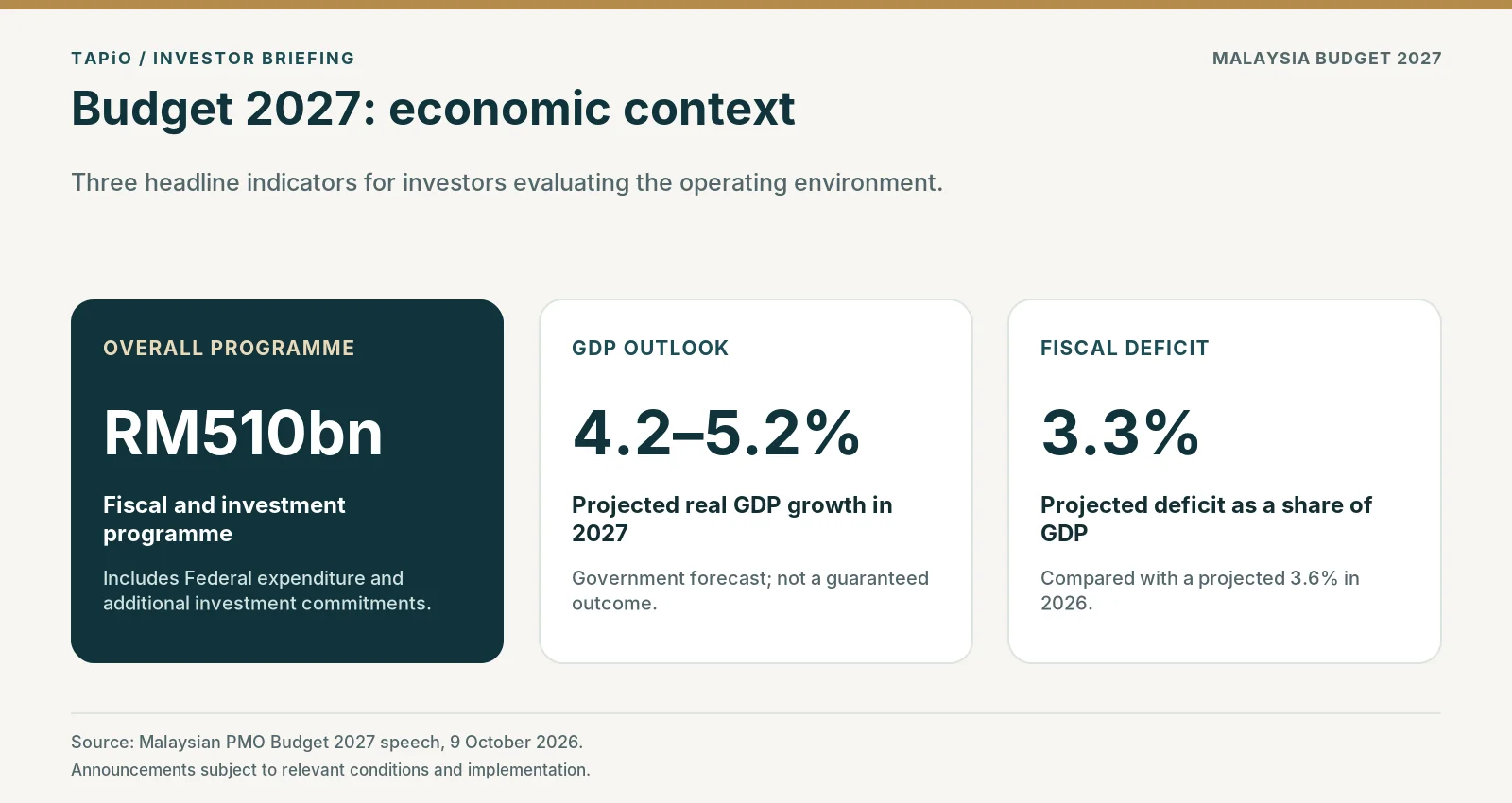
The Government projects economic growth of 4.2% to 5.2% in 2027 and a narrower fiscal deficit of 3.3% of GDP, compared with an estimated 3.6% in 2026. The stated RM510 billion programme encompasses Federal expenditure and additional investment commitments, rather than representing direct Federal Government expenditure alone.
For foreign investors, the most useful reading is not a complete list of budget allocations. It is an assessment of which announced measures may influence the practical decision to establish, expand or coordinate business activities from Malaysia.
Regional business hubs: a longer incentive horizon
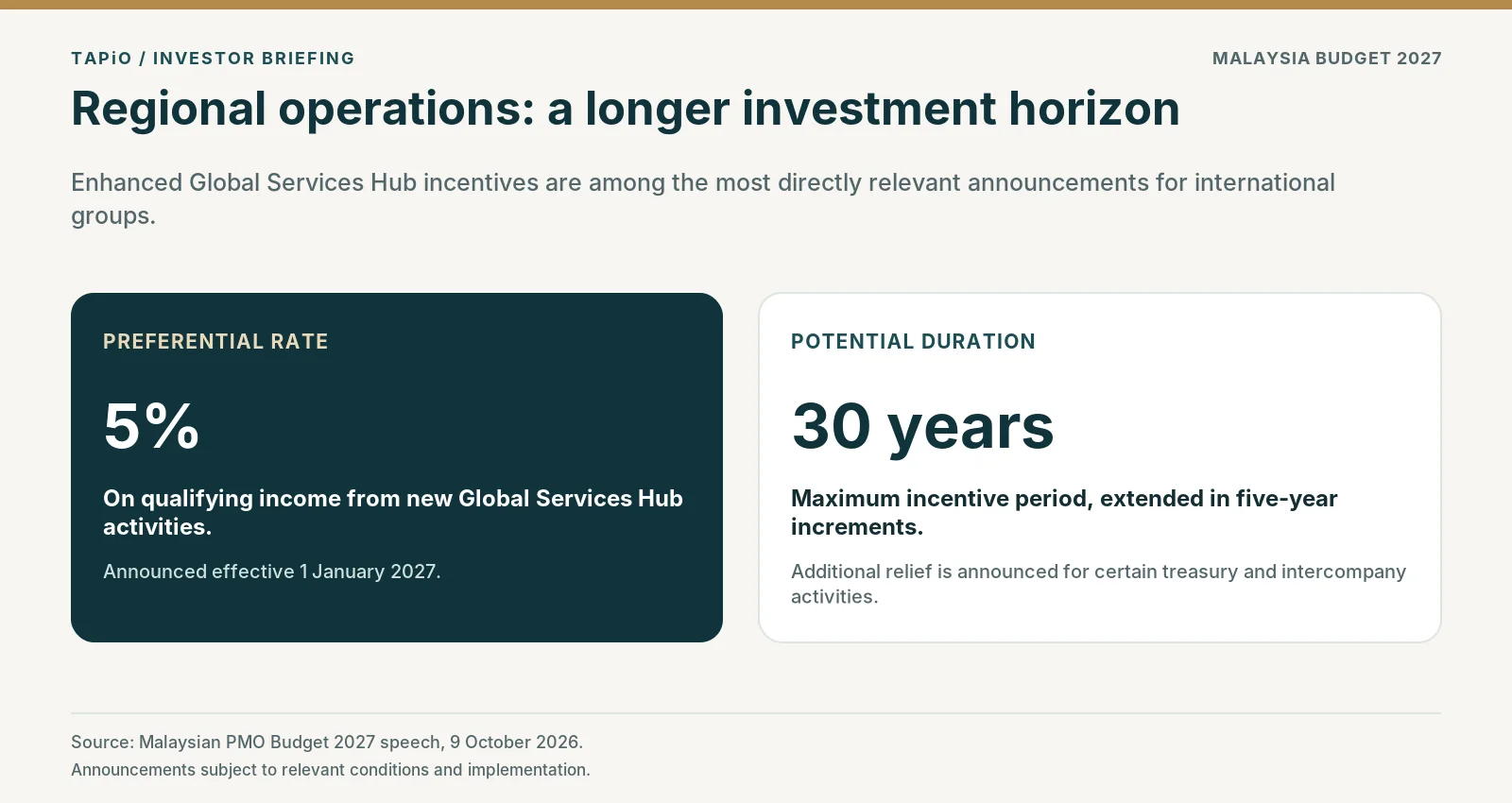
The enhancement of Global Services Hub (GSH) incentives from 1 January 2027 is among the Budget’s clearest announcements for international companies. New qualifying GSH operations are proposed to receive a preferential 5% income tax rate on eligible hub activities. For existing qualifying Principal Hub or GSH companies, the announced 5% preferential rate applies to income above a specified baseline.
The incentive may operate in five-year increments for a maximum of 30 years. The Budget also proposes withholding tax and stamp duty relief for specified treasury and intercompany financing arrangements, including qualifying activities under the Johor-Singapore Special Economic Zone incentive package.
For groups assessing regional management, support functions or treasury operations, the longer potential incentive horizon is relevant to investment planning. It should nevertheless be assessed against the actual qualifying activities, economic substance requirements, detailed conditions and any applicable global minimum tax considerations. The announced headline rate should not be assumed to be the final effective rate for every group.
Advanced industry and a stronger Malaysian supplier ecosystem
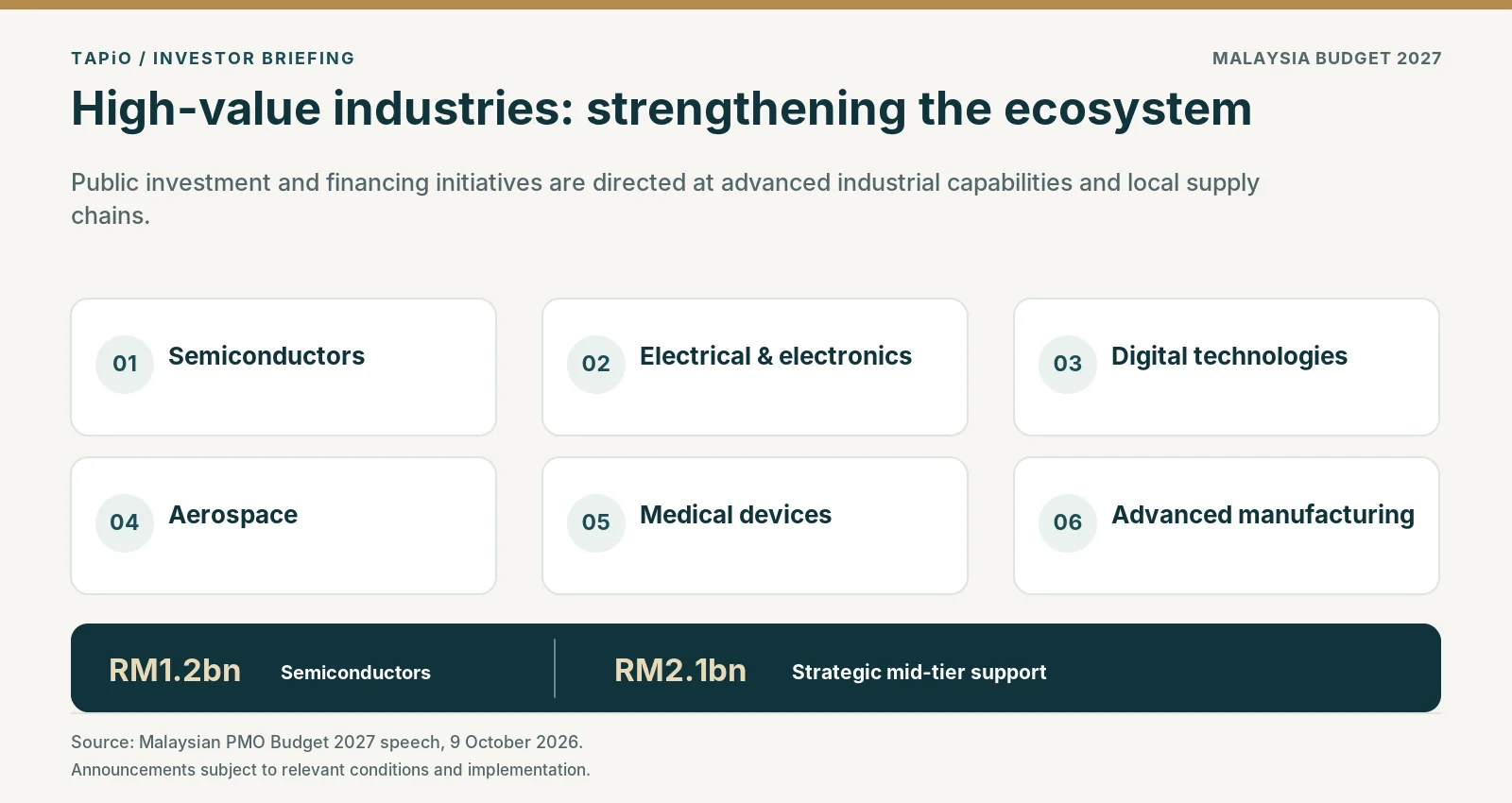
The Budget continues support for semiconductors, electrical and electronics, digital technology, aerospace, medical devices and related high-value industries. Announced measures include RM1.2 billion in investment by Khazanah Nasional and KWAP to support local semiconductor capability, and RM2.1 billion through industrial and investment funds to strengthen mid-tier companies in strategic sectors.
A further RM100 million Strategic Investment Fund involving Khazanah and InvestPenang is intended to support younger semiconductor and advanced manufacturing businesses. Additional initiatives address technology startups, commercialisation, advanced packaging and artificial intelligence adoption.
Much of this institutional capital and financing is directed towards eligible Malaysian companies. For international businesses, the broader relevance is the development of local engineering, supplier, research and industrial capabilities, as well as potential commercial cooperation with domestic businesses. Support for a sector should not be interpreted as an automatic grant or tax incentive for every foreign-owned operation.
Energy transition and infrastructure for long-term investment
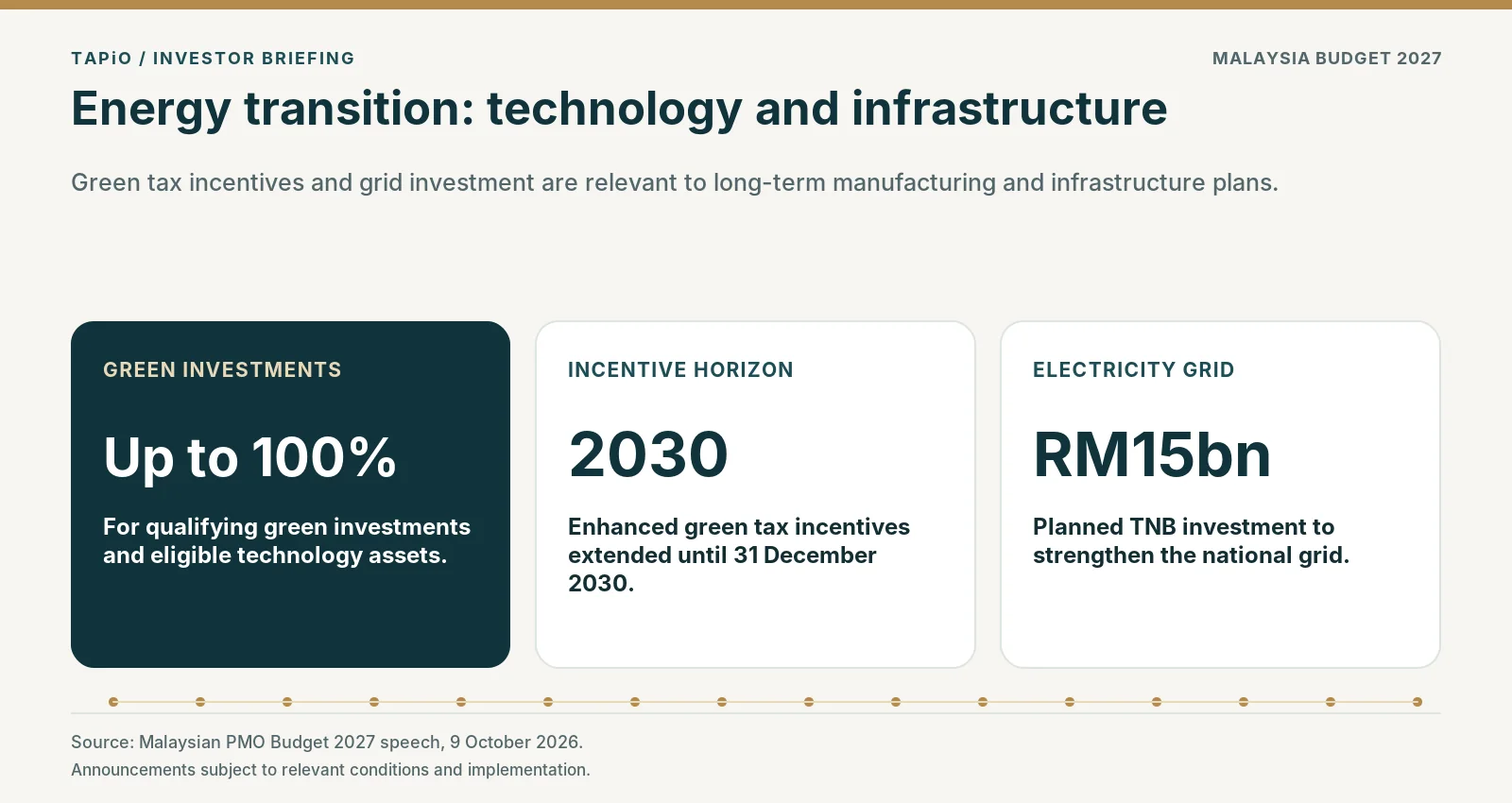
Energy resilience is another investment-related theme. Tenaga Nasional Berhad is expected to invest RM15 billion to strengthen the national electricity grid, and Budget 2027 identifies additional institutional funding for renewable energy, storage and decarbonisation.
Green technology tax incentives are proposed to be enhanced and extended until 31 December 2030. Qualifying green technology projects, electric vehicle charging infrastructure and certain eligible assets acquired for companies’ own use may benefit from an Investment Tax Allowance of up to 100%, subject to the detailed rules.
For manufacturing, data infrastructure and energy-intensive projects, these announcements belong alongside location-level verification of available utility capacity, connection timing and the conditions of any proposed investment incentive. Announced infrastructure spending is a useful national signal but does not, by itself, establish capacity at a particular site.
Skilled talent and international mobility
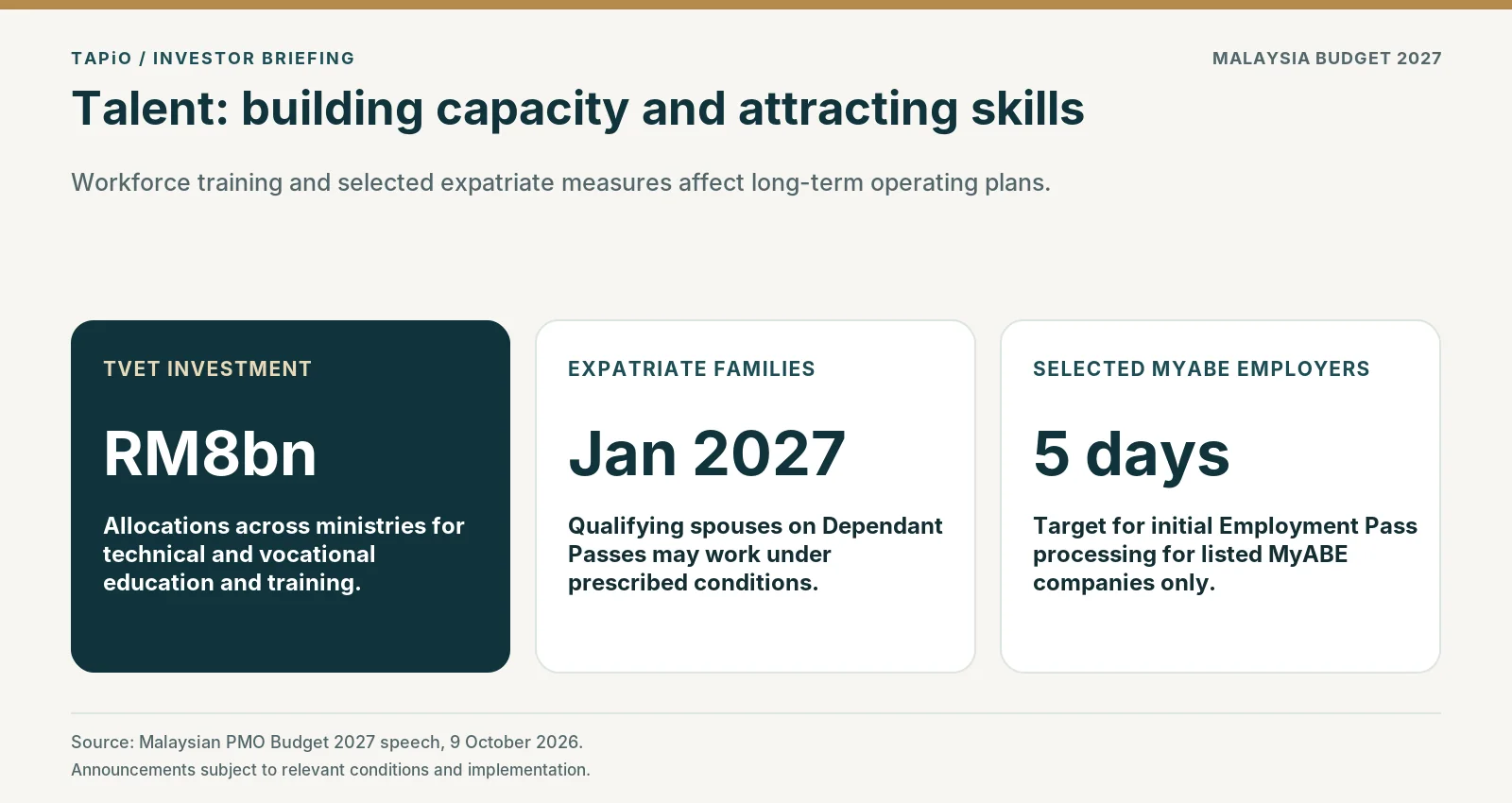
Malaysia’s ability to support higher-value activities also depends on available technical and management skills. The Budget provides RM8 billion in total technical and vocational education and training allocations across ministries and includes additional programmes for technology skills, industrial employment and AI capabilities.
Two mobility measures deserve attention from multinational employers. From 1 January 2027, spouses who hold Dependant Passes linked to Category I Employment Pass holders are to be allowed to work in Malaysia, subject to prescribed requirements. Separately, a five-working-day target for the initial Employment Pass application process is specified for listed Malaysian ASEAN Business Entity (MyABE) companies. This is a targeted process, not a general five-day promise for every expatriate application.
The Budget also announces tax deductions for eligible employers delivering Bakat MADANI training programmes. These measures strengthen the policy framework for talent development while leaving individual hiring, immigration eligibility and programme conditions to be assessed case by case.
Malaysia as a base for business across ASEAN
Budget 2027 supports improvements in cross-border trade and logistics links with Malaysia’s ASEAN neighbours. Announcements cover northern trade connections with Thailand, land connectivity with Indonesia through Sabah and Sarawak, and the continuing development of economic corridors in the south.
For international investors, the relevance is broader than any single economic zone. Malaysia can be evaluated as a base for regional management, procurement, technical support, distribution and market development, depending on the company’s customers, supply chain and operating requirements.
A Malaysia-based regional structure does not remove the need for market-specific assessment elsewhere in ASEAN. Distribution, product approvals, customs, employment and local commercial arrangements continue to depend on the rules and practical conditions of each destination market.

Local enterprise support and partnership opportunities
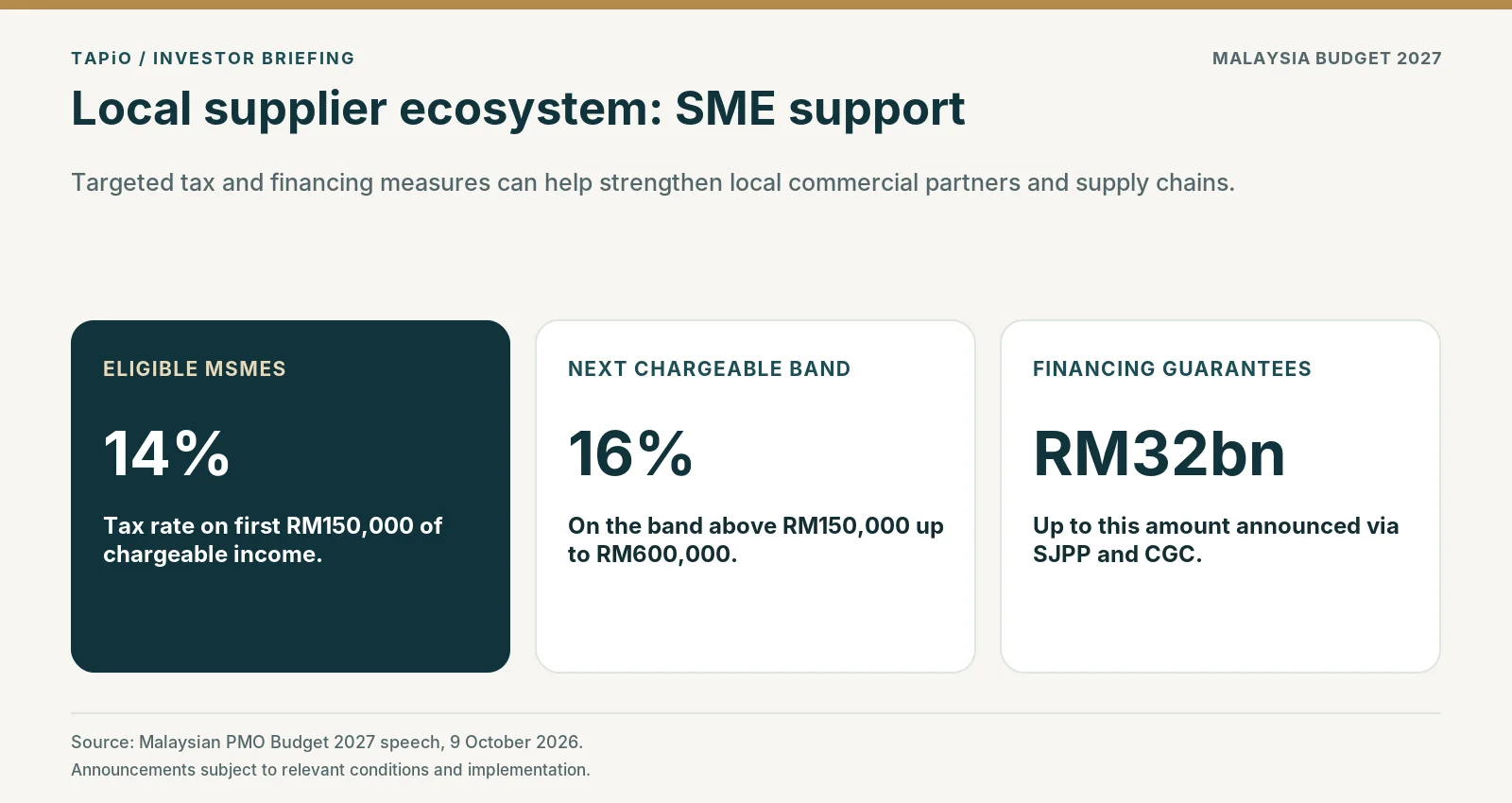
The Budget proposes lowering corporate income tax rates for qualifying micro, small and medium-sized enterprises to 14% on the first RM150,000 of chargeable income and 16% on the subsequent band up to RM600,000. It also announces up to RM32 billion in financing guarantees through SJPP and CGC, along with capital allowance, productivity and financing measures.
These initiatives are principally designed to assist eligible domestic enterprises. For incoming companies, their significance may be found in a more capable network of local suppliers, distributors, service providers and prospective commercial partners. Eligibility should be checked before incorporating any assumed benefit into a business case.
Other Budget developments worth noting
Workforce planning and compliance. The general minimum wage is scheduled to rise from RM1,700 to RM2,000 in June 2027, with the Budget announcing an exemption for MSMEs whose annual sales are below RM50 million. Non-MSME businesses should also note the proposed link between wage tax deductibility and salary payments through bank accounts using channels permitted under the Employment Act 1955. Employers should refer to implementing guidance for the precise scope and effective requirements.
Domestic market conditions. Increased individual tax relief and reductions in selected personal income tax rates are intended to support household disposable income. The combined allocation for Sumbangan Tunai Rahmah and Sumbangan Asas Rahmah assistance is set to rise to RM16 billion in 2027. These measures are relevant background for consumer-oriented businesses, although they are not a substitute for product-specific demand research.
Transport and financial services. The Budget provides for continued road, rail, port-area and airport improvements, including RM1.1 billion for selected port-area roads and airport upgrades. It also extends incentives for qualifying Malaysian shipping businesses and announces further support for selected fund management and family office activities.
Digital trade and administration. An E-Commerce Bill is expected to be tabled, while administrative simplification initiatives continue. Companies entering digital distribution or platform businesses should monitor the final legislation and applicable compliance requirements.
What should an international investor take from Budget 2027?
Budget 2027 reinforces Malaysia’s stated direction towards higher-value investment, stronger domestic enterprise capabilities, infrastructure development and greater regional business connectivity. The Global Services Hub improvements are particularly relevant for regional operations, while industry and talent programmes may support longer-term manufacturing and service-sector development.
The practical next step is to distinguish announced policy from confirmed eligibility. An investment assessment should test the proposed operating activities, applicable incentive rules, suitable locations, local supplier depth, workforce availability and cross-border commercial model together.
For companies considering Malaysia as an entry market or ASEAN operating base, the Budget offers useful new information for their planning. A sound decision will still rest on how the announced measures apply to the particular business and its intended operations.
Sources and publication note
This is an investor-oriented overview of announcements available as at 11 October 2026. Proposed incentives and measures remain subject to legislation, detailed conditions and implementation guidance. Nothing in this article constitutes individual tax, legal or investment advice.